The quiet nutrient driving yield, resilience, and starch—without the headlines.
by GMJoe™
One suspects that if potassium had better press, we might speak of it the way we do of gold—critical, coveted, vaguely mythic. But alas, it has no lobby, no branding, no spokesman with perfect teeth. It does its work without applause, quietly orchestrating the life of the potato from the darkness of the soil upward. As with many things essential, its absence is most acutely felt only after the fact—when the yield is off, the skin is poor, the starch is dull, and the farmer begins to whisper about weather, or seed, or luck.
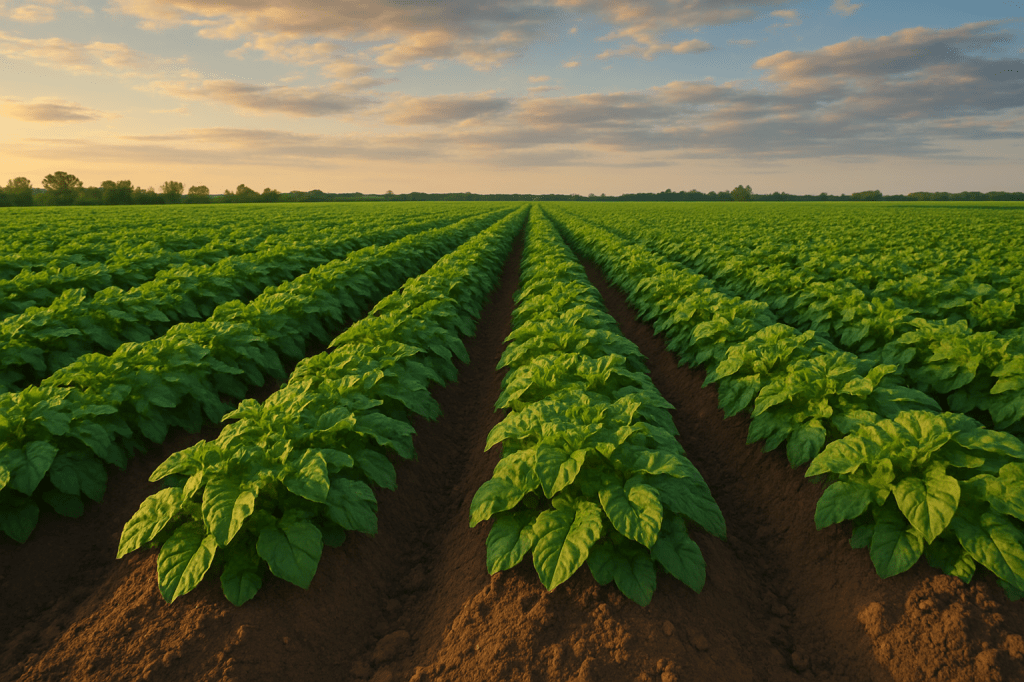
Yet there it is, potassium, in staggering quantities, coursing through the plant across the season. Not for flair or flourish, but because the whole operation depends upon it. Tuber development? That’s potassium. Starch content? Potassium again. Nutrient transport, stress resistance, water regulation? One might be tempted to ask what isn’t potassium.
It does not shout. It does not seduce. It simply moves sugars and minerals where they must go, fortifies cell walls, and keeps the very vascular system of the plant from collapsing in protest during heat, drought, or other natural indignities. If nitrogen is the exuberant showman and phosphorus the cerebral architect, potassium is the statesman—measured, stabilizing, never flashy.
Of course, we live in an age that confuses visibility with importance. And so potassium, that loyal steward, is too often relegated to a secondary role in the minds of those who should know better. Fields underperform, roots stall, and some poor extension agent is called in to diagnose a problem that—if we’re honest—should never have emerged in the first place. There is a difference between treating a field and understanding it.
This is not merely agronomic commentary. It is, in a way, moral. For how a civilization treats its soil is never far removed from how it treats its institutions, its memory, or its quiet virtues. We would do well, then, to look again at potassium—not as an input to be managed, but as an ally to be honored. Not everything valuable makes a sound. Some things simply hold the whole system together.
One imagines that, in a more enlightened republic, there would be annual banquets for potassium. Toasts raised. Medals given. A poet laureate might be commissioned to reflect on its unseen labors in the rhizosphere. But we are moderns, and moderns have little patience for the invisible. We prefer theatrics. We gravitate toward crisis. Potassium, in its reliability, denies us both.
And yet it is precisely this quiet reliability that forms the basis of agricultural civilization. The potato, humble in the tuber yet audacious in global consequence, has nourished empires and sustained peasantries alike. It has been the difference between survival and starvation, surplus and rebellion. Its robustness, often lauded, does not appear ex nihilo. It is built—layer by layer, cell by cell—on the back of precise chemical balance, of which potassium is chief engineer.
Still, the industry, enthralled as it is by technologies that blink, buzz, or promise revolutions, often turns its gaze elsewhere. And who can blame it? Potassium does not advertise. It does not predict futures, disrupt markets, or claim proprietary rights. It is mineral, elemental, utterly democratic. It functions not through spectacle but through constancy.
Of course, one could argue that we need not mythologize it. That agriculture, like government, should remain practical. But the practical, if it is to endure, must also be understood. And if potassium remains misunderstood—seen merely as a checkbox on a fertilizer spreadsheet—it will be misapplied, under-applied, or, most damningly, assumed.
And assumption, in both governance and farming, is always the first step toward decline.
There is a lesson here for those who care to look. The most important actors, in any system, are often those whose work prevents collapse rather than those who arrive, with much fanfare, to respond to it. In our fields, as in our institutions, it is the quiet custodians that ensure continuity. Potassium, silent sentinel of the soil, may never get the credit it deserves. But the potato knows. And the harvest does not lie.
Let us then propose a modest reversal of values—not merely in fertilizer priorities, but in how we assign esteem. It is a curious flaw in the human species that we so often elevate the spectacle while neglecting the infrastructure. We praise the bloom, forget the root. We toast the yield, ignore the mineral that made it possible. We chase innovation as if the fundamentals had suddenly become passé.
But the truth, inconvenient though it may be, is that no drone, no sensor, no artificially intelligent crop advisor can compensate for an exhausted soil misfed. There is no algorithm for wisdom, no software patch for a misread nutrient profile. And potassium, enduring and unbothered, remains what it has always been: the crucial difference between a field that promises and a field that delivers.
In the end, the lesson is as agronomic as it is philosophical. That which does the most work often asks for the least praise. That which keeps things from falling apart rarely makes headlines. And if civilization is, as some have argued, the triumph of order over chaos, then surely potassium is one of its silent architects—drawing no salary, issuing no complaints, but holding the line against entropy, one tuber at a time.
It is, if we may be allowed a moment of heresy, a kind of nobility—mineral, mute, and utterly incorruptible. Not bad company, in an age where so much else has made a spectacle of decline.

GMJoe™
“Potassium doesn’t make noise—but it makes yield. And that’s the kind of power worth remembering” ~ Copyrighted by GMJoe™ Consulting ©2025 All Rights Reserved
 GMJoe™ Consulting